devwatch-github
GitHub Devwatch for Chrome
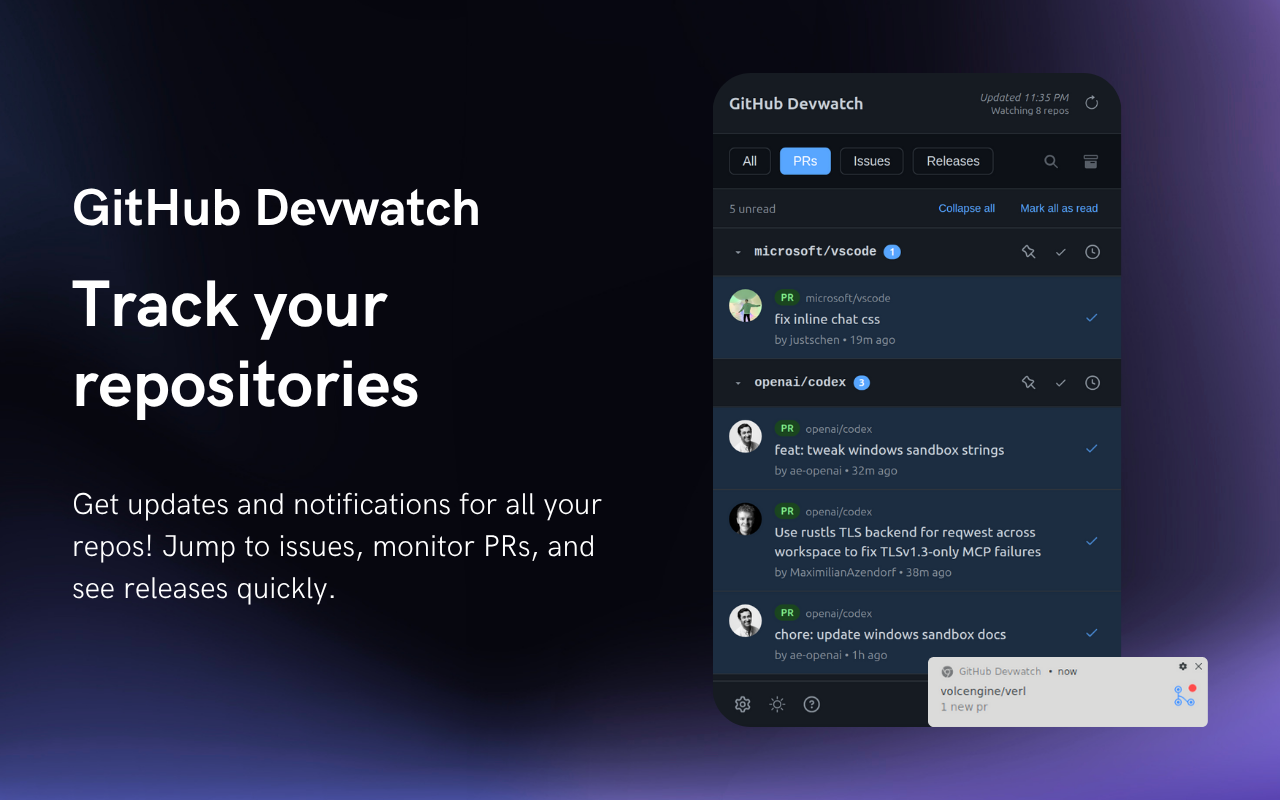
Monitor pull requests, issues, and releases across multiple GitHub repositories from a Chrome extension. It keeps a local activity feed, badge counts, and optional browser notifications without adding another hosted service to the workflow.
Best for people who follow several repos and want one local review queue instead of GitHub email noise, browser-tab sprawl, or constantly checking each repository by hand.



Key Features
- Guided Setup - Built-in GitHub sign-in flow and repository selection
- Browser Notifications - Get notified about new PRs, issues, and releases
- Multi-Repo Monitoring - Watch up to 50 repositories by default, with an advanced option to go beyond that
- Configurable Updates - Check every 5, 15, 30, or 60 minutes
- Activity Filtering - Search and filter by repo and activity type
- Repo Controls - Pin favorites, mute noisy repos, or snooze them temporarily
- Flexible Repo Input - Add repos with
owner/repo, a GitHub URL, or an npm package name - Badge Counts - Unread count on the extension icon
- Direct API Access - Talks to GitHub directly, with optional npm registry lookups only when you use package-name import
Requirements
- Chrome or another Chromium-based browser that supports Manifest V3 extensions
- A GitHub account to connect during setup
- No separate hosted DevWatch account or backend service
- GitHub sign-in lasts for the current browser session and is cleared when that session ends
Installation
From Chrome Web Store (Recommended)
- Visit the Chrome Web Store
- Click “Add to Chrome”
- Grant permissions when prompted
- Follow the guided setup wizard on first launch
GitHub Sign-In Permissions: DevWatch uses GitHub OAuth device flow and requests repo plus read:user so it can monitor private repositories and show the connected account in the UI. The current build uses one sign-in path for both public and private monitoring, so there is not a separate public-only permission mode yet.
Manual Installation (For Development)
- Clone this repository
git clone https://github.com/jonmartin721/devwatch-github.git cd devwatch-github npm install - Load the extension in Chrome:
- Open Chrome and go to
chrome://extensions/ - Enable “Developer mode” (toggle in top right)
- Click “Load unpacked”
- Select the extension directory
- Open Chrome and go to
- Click the extension icon and follow the setup wizard
Quick Setup
First-Time Setup
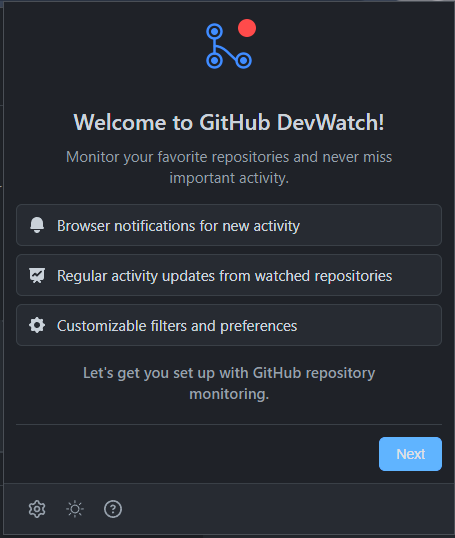
The built-in setup flow walks you through:
- Connect your GitHub account
- Add repositories to watch
- Choose activity types (PRs, Issues, Releases)
Ongoing Use
- The extension automatically checks for activity at your configured interval (default: 15 minutes)
- Click the extension icon to view your activity feed
- Get browser notifications for new activity
- Badge count shows unread items at a glance
- Use the archive to revisit read items or clear them when you’re done
- Pin, mute, or snooze repositories to control noisy feeds
- Manage repositories and preferences anytime in Settings
How to Use
Popup Interface
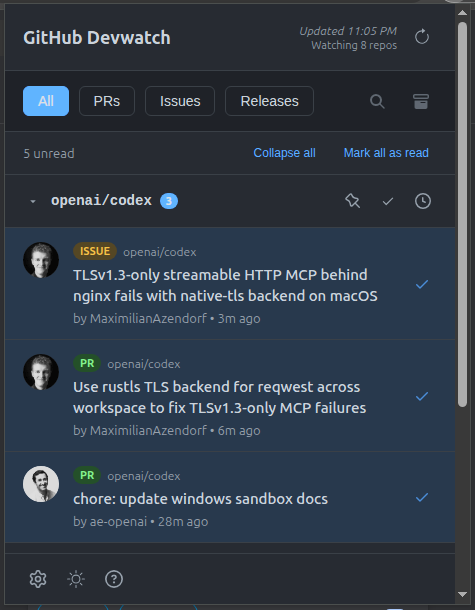
The popup is the main day-to-day view:
- Filter by type (All/PRs/Issues/Releases)
- Search across activity in watched repositories
- Refresh manually, browse the archive, and open any item in GitHub
- Pin favorite repositories or snooze noisy ones to keep the feed focused
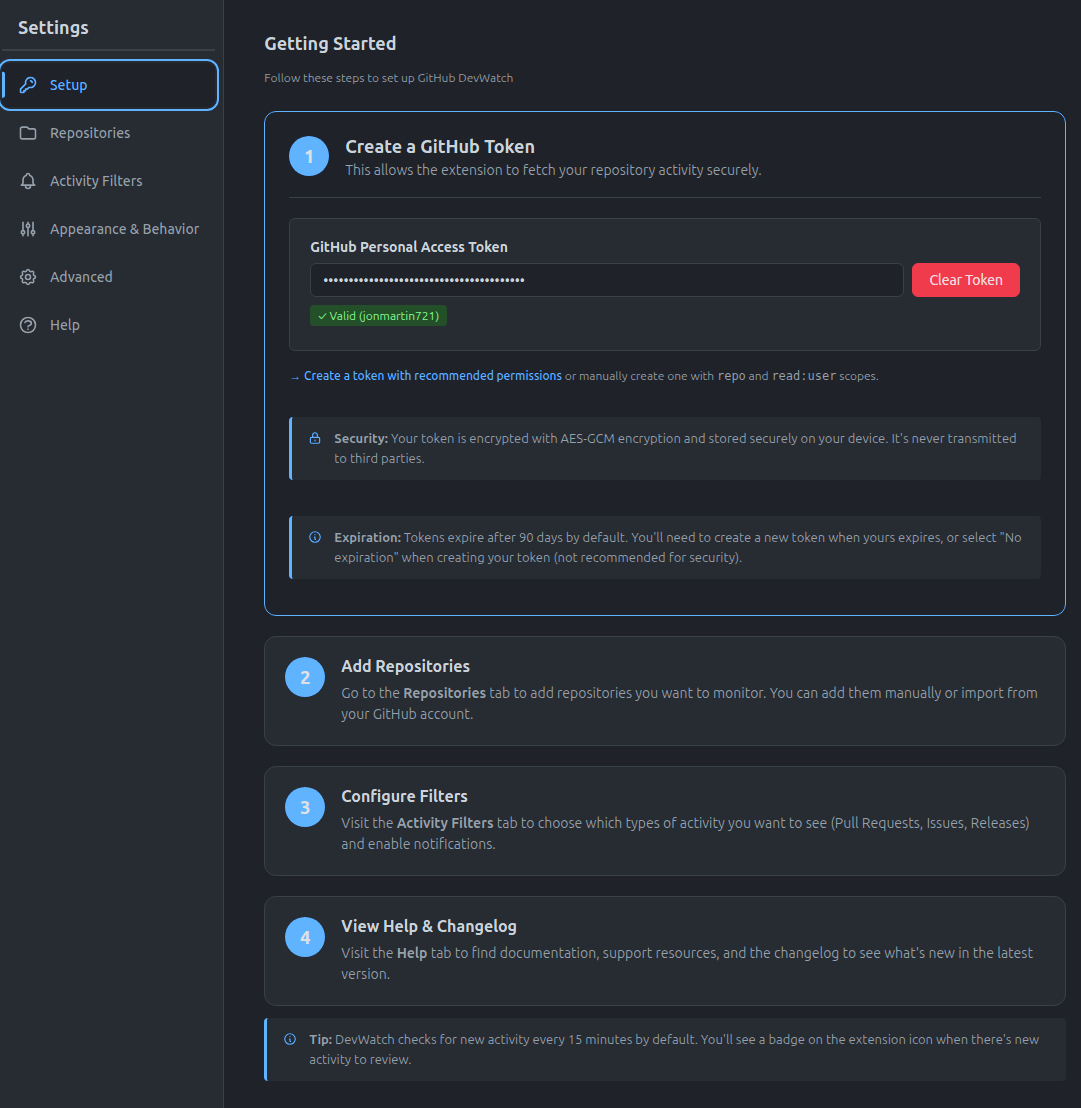
Settings Page
Settings are split into a few practical jobs:
- Connect GitHub, add repositories manually, or import them from your account
- Tune filters, notifications, refresh interval, snooze behavior, and item expiry
- Change theme/color theme, export or import settings, and enable advanced repo-limit options
Typical Workflow
Here’s what using the extension looks like day-to-day:
- A browser notification or badge count lets you know there is new activity.
- Open the popup to scan updates across your watched repositories in one place.
- Open the item in GitHub when you want to review it, and let DevWatch keep the rest of the queue visible locally.
The extension keeps up to 2000 items in your local history, so you can always check something you saw earlier. Badge count updates automatically as you read items.
Accessibility Notes
The UI includes keyboard navigation, visible focus styles, semantic controls, and ARIA labeling in key flows. The test suite also includes automated axe-core checks and keyboard-focused UI tests.
That said, this project has not gone through a formal accessibility audit or documented screen reader certification. If you run into an accessibility issue, please open an issue.
Privacy & Security Notes
The extension talks directly to GitHub’s API and does not use a separate analytics or sync backend. It stores settings and cached activity in Chrome extension storage, while the current GitHub auth session stays in Chrome session storage so it is not persisted to disk. Legacy encrypted auth data from older builds is cleared when accessed.
- Direct network access - Requests go to
api.github.comfor activity checks,github.comfor OAuth device-flow sign-in, andregistry.npmjs.orgonly when you use package-name lookup - Scoped browser permissions - The manifest asks for
storage,alarms, andnotifications - Defensive client code - The codebase includes URL validation, content security policy rules, and sanitization tests
- No formal audit claim - These measures improve the local handling of data, but they are not a substitute for securing the browser profile and GitHub account you use with the extension
Data Storage
The extension stores up to 2000 activity items locally in Chrome storage. This limit ensures the extension stays performant while providing plenty of history.
Feed Management
You can optionally configure automatic expiry of old items:
- Auto-removal: Enable time-based expiry to automatically remove items older than a specified time
- Configurable Duration: Set expiry time from 1 to 168 hours (1 week)
- Applies to All Items: When enabled, both feed and archived items older than the threshold are removed
- Manual Control: Clear archive manually anytime with the “Clear Archive” button
Items are automatically removed when they exceed the 2000 item limit (keeping the most recent) or when they’re older than your configured expiry time (if enabled).
Rate Limiting
GitHub gives authenticated users 5,000 API requests per hour. Each repo check uses 1-3 requests, so even checking 50 repos every 15 minutes keeps you well under the limit.
The extension defaults to checking every 15 minutes. You can change this to 5, 30, or 60 minutes in settings. The default 50-repo limit is there to keep rate usage predictable, but Advanced settings also let you enable unlimited repositories if you want to trade more flexibility for more rate-limit risk.
Development
Project Structure
/devwatch-github
  /icons                  # Extension icons in various sizes
  /popup                  # Popup interface
    /controllers         # Popup business logic
    /views               # Popup view components
    popup.html
    popup.js
    popup.css
  /options                # Settings page
    /controllers         # Settings business logic
    /views               # Settings view components
    options.html
    options.js
  /shared                 # Shared utilities
    /api                 # GitHub API integration
    /ui                  # Shared UI components
  background.js           # Service worker for background tasks
  manifest.json           # Extension manifest (Manifest V3)
Technologies Used
- Vanilla JavaScript - No frameworks, pure JS for maximum compatibility
- Chrome Extension Manifest V3 - Latest extension standards
- GitHub REST API - Direct integration with GitHub’s API
- Chrome APIs - Storage, Notifications, and Alarms for core functionality
Running Tests
npm run lint
npm run typecheck
npm test
npm run build
The automated checks cover shared logic, UI behavior, and a range of mocked extension flows. They do not replace manual testing in Chrome for permissions, service worker lifecycle behavior, or end-to-end interactions against live GitHub data.
Jest enforces minimum global coverage thresholds of 47% lines, 46% branches, and 44% functions. That is a floor for the suite, not a claim of exhaustive coverage.
Local Development
- Clone the repository
- Run
npm installfor dependencies - Load as unpacked extension in Chrome
- Make changes and reload the extension from
chrome://extensions/
Contributing
Contributions welcome! Submit issues or pull requests. See CONTRIBUTING.md for guidelines.
How to Contribute
- Bug Reports: Use GitHub Issues with clear reproduction steps
- Feature Requests: Open an issue describing the feature and use case
- Pull Requests: Fork, branch, and submit with clear commit messages
- Code Style: Follow existing patterns and use ESLint configuration
Documentation
- Privacy Policy - How we handle your data
- Changelog - Version history and release notes
- License - MIT License
- Contributing Guidelines - How to contribute
Roadmap
This is an actively maintained side project. Some features under consideration:
- Comment notifications - Track new comments on issues and PRs
- Mention tracking - Get notified when you’re mentioned
- Multiple GitHub accounts - Switch between different accounts
- Browser redirect sign-in - Offer a less manual alternative to the current device-flow sign-in
- Internationalization - Support for multiple languages
- Dashboard view - Full-page dashboard for all activity
If any of these sound useful, open an issue or submit a PR!
License
MIT License - see LICENSE file for details.
Copyright (c) 2025 Jonathan Martin
Support
- Report issues: GitHub Issues
- Feature requests: GitHub Discussions